History
Four years on sale. Thirty-four without a replacement.
Agenda shipped in 1988, Lotus stopped developing it after 1990, and the last release came in 1992. Its designers published how it worked, the company replaced it with something completely different, and then nobody picked the idea back up.
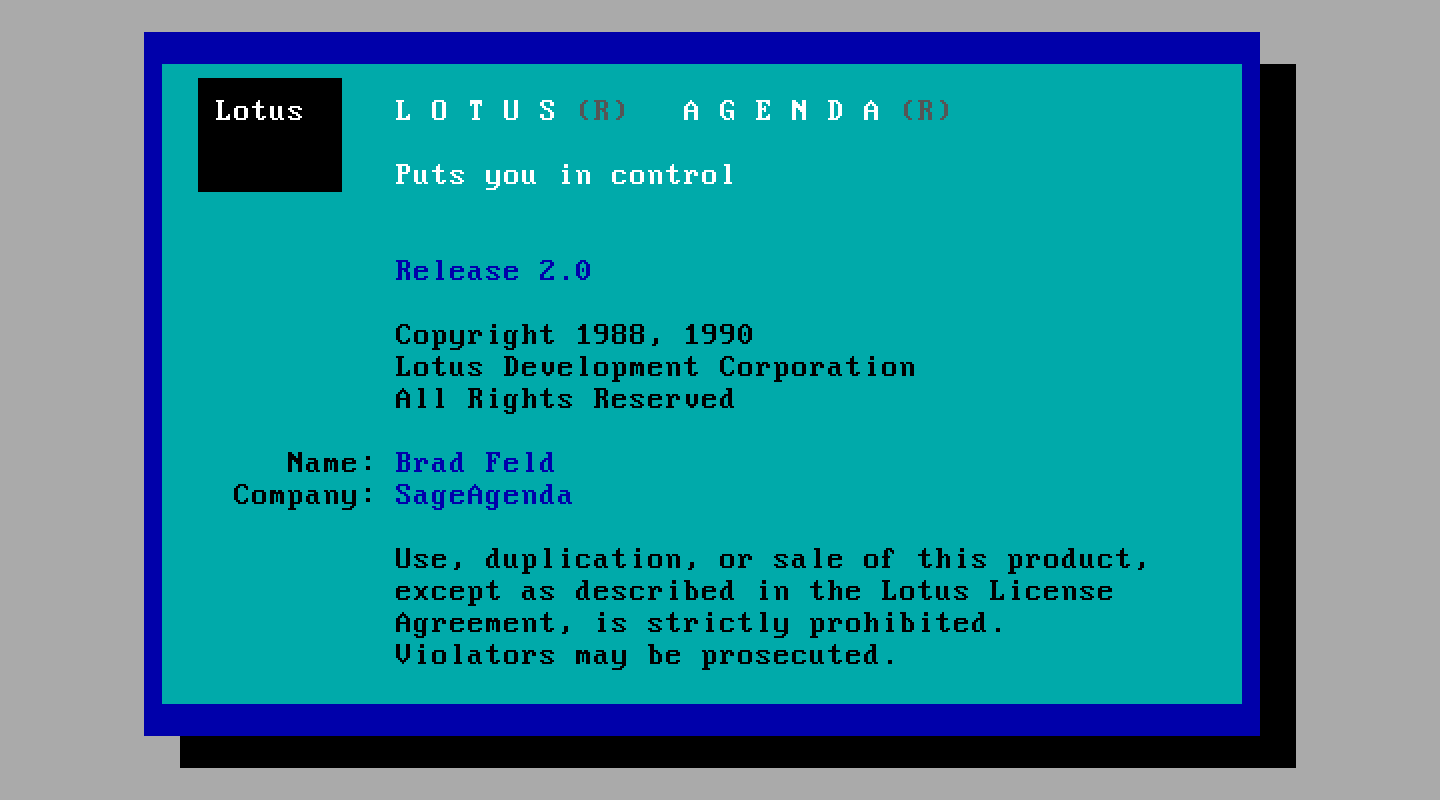
Agenda 1.0 ships
Designed at Lotus by Mitch Kapor, Ed Belove, and Jerry Kaplan, with Todd Drake and Richard Landsman. Kapor had stepped down as Lotus's chairman in 1986 but says he kept working on Agenda after that; it was the last thing he did there. Kaplan co-founded GO in 1987. Lotus filed the patent on the design on 1 November 1988. Copyright notices in the manuals run 1988, 1989, and 1990.
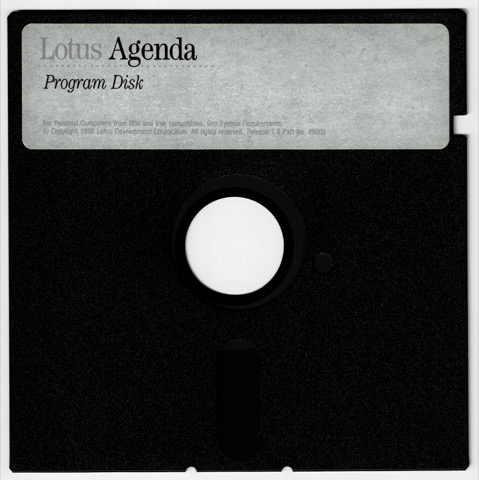
The documentation set
Six manuals are dated to this year, including a Users Guide running past 700 pages. Computer Chronicles demonstrates Agenda live; the episode survives.
Release 2.0, and the paper
All five designers publish “Agenda: A Personal Information Manager” in Communications of the ACM 33(7):105-116. Publishing your architecture while the product is still on sale was strange then and would be stranger now. It's the only reason I can rebuild this at all. 2.0 for DOS ships in August and that is the end of the line: Windows and Macintosh versions were started and cancelled by Lotus management before they were finished.
The patent lands, Organizer replaces it
2.0b is the last release. Lotus moves to Organizer, a Windows product built on a paper-diary metaphor. It's a different program wearing the same job title, and Lotus didn't even build it - Organizer came from Threadz, a small British software house, and Lotus bought it. The same year, on 19 May, the patent on Agenda's data structures is granted: US 5,115,504, six inventors, the five authors and Stephen Zagieboylo. Agenda 2.0 comes out later as freeware, binaries only. Lotus never released the source.
Chandler
Kapor's own attempt at a successor runs six years and then shuts down. It tried to be a calendar, an email client, a collaboration tool, and a platform at the same time. Scott Rosenberg's Dreaming in Code documents the whole thing from inside. It's where my scope fence comes from.
Ormandy's excavation
Tavis Ormandy publishes stfjson to convert Agenda's export format on 21
October, and uploads all six scanned manuals to the Internet Archive the next
day. His FAQ on running Agenda under DOSEMU2 - still the best modern account -
carries no date; the earliest copy of it anywhere is from 2021.
Beeswax, and this
Ross Palmer Mohn picks up a Rust TUI reimplementation he abandoned in 2008 and is using it every day by April. That's the proof the engine tier is doable. I start SageAgenda in September, for the web.
The people
Five authors on one architecture paper is unusual, and it's why I can recover the design at all.
Mitch Kapor
Co-founded Lotus in 1982 with Jonathan Sachs and designed 1-2-3. Stepped down as chairman in 1986 and finished Agenda anyway. Co-founded the EFF in 1990, chaired the Mozilla Foundation from 2003, and spent the 2000s on Chandler, trying to rebuild this idea. Didn't get there. In his 2004 oral history: “My favorite product was Agenda.”
Ed Belove
Edward J. Belove. First name on the paper and on the patent, both alphabetical. At Lotus he worked on Agenda, Improv, and Magellan; before that he co-founded a company that put Apple IIs on early online services, and after it he ran Ziff Davis's Interchange. An angel investor in Boston since 1992, who says he still runs into people using Agenda.
Jerry Kaplan
Hired by Lotus as principal technologist to build software on AI techniques. Agenda was that software. Co-founded GO Corporation in 1987, the idea having come on a plane ride with Kapor, and wrote Startup about how pen computing ended.
Todd R. Drake
Co-author on the architecture paper and co-inventor on the patent. An earlier version of this page called him Steve; the byline and the patent both say Todd.
Richard A. Landsman
Co-author and co-inventor. Senior technology roles at Lotus, Borland, Intertrust, AOL-Time Warner, and Openwave, and last CTO of Open-Xchange. Twenty-seven issued patents, this one among them. Died in 2017, at 64.
Tavis Ormandy
Modern archivist. Scanned and uploaded all six manuals in 2020, wrote the definitive account of getting Agenda running today, and built stfjson.
Ross Palmer Mohn
Author of Beeswax, the Rust TUI reimplementation in daily use since April 2026.
Why it didn't survive
I don't have a single answer and the archive doesn't pretend to. What the sources support is this. Agenda was text-mode while the market moved to Windows. It asked people to think in a way no other program had taught them. And Lotus decided to compete with a conventional organizer instead of defending an unconventional one.
Kapor's own account, given to the IEEE in 1993, is that Lotus tried more new kinds of product than any competitor and with no coherence between them, and that Agenda got the reviews and the devoted users and not the sales. Fallows's numbers say what “not the sales” meant: about 200,000 copies at $195 over its life, which, as he puts it, was not enough to keep Lotus in the game.
The question I keep coming back to is why nothing since has reproduced it. Tagging came back everywhere - Roam, Tana, Capacities, Obsidian, and Org mode. The assignment half never did.