Lotus Agenda, 1988-1992
I ran my first company on this.
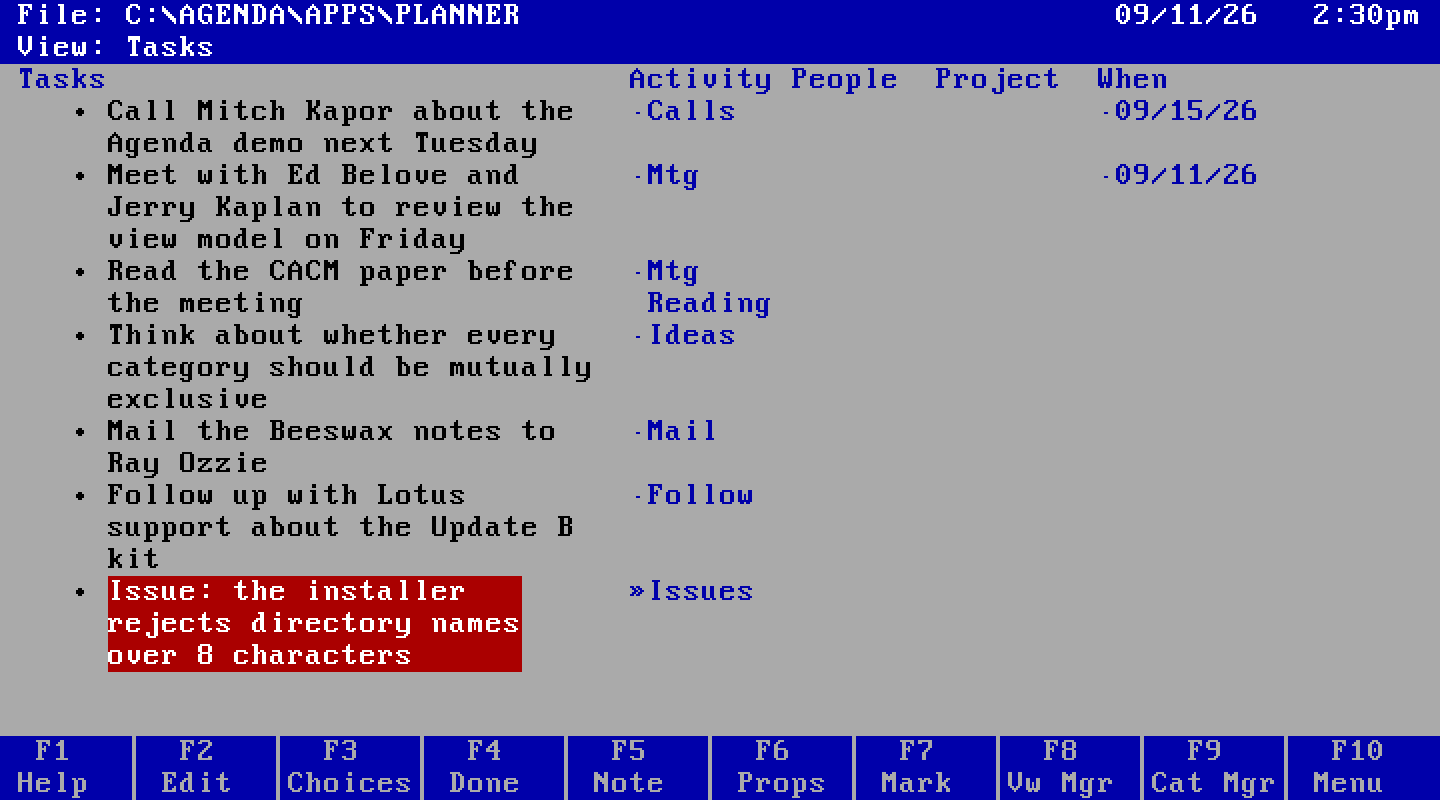
Agenda was a DOS program that let you type things and then it automatically figured out what to do with them (e.g. categorize them, assign dates, assign tags). You typed something. It filed. The structure of the database showed up after the content, and it kept changing dynamically as more content was added. It was brilliant.
I used it from 1990 to 1993. I've never found anything as good, so I'm trying to rebuild it for the web from the design document that was published in 1990.
The idea nobody rebuilt
Roam, Tana, Capacities, and Obsidian all let you tag whatever you want and query it later. That's the easy half of Agenda. The other half is that it read what you wrote and filed it for you. It also knew when to ask instead of assume.
Automatic assignment
The category hierarchy is a program that runs against every item you change. Categories carry conditions and actions. Match the conditions and you get assigned, which fires the actions, which can send the item back through. Two dials govern the whole thing: Initiative, or how strong a match has to be, and Authority, or whether to act now and tell you later.
Update through views
Put an item in a section and it joins that section's category. Put it in a filtered view and Agenda runs the criteria backwards so the new item satisfies them. Editing a view edits the database. The 1990 paper describes this and then declines to say how it works. Nobody has rebuilt it since.
Tana makes you tag. Agenda tagged you.
The archive
I'm collecting everything on the web about Lotus Agenda in one place.
The idea
Four primitives, two relations on the hierarchy, and the two mechanisms that made Agenda more than a tagging tool.
Read →Screens
The original, running today, captured doing the thing: seven sentences typed in, every one filed. Plus the boxes and menus behind it.
Look →History and people
Agenda shipped in 1988 and its last release came in 1992. All five of the creators published how it worked. Two people have tried to bring it back. One of them was Kapor.
Read →Sources
There are 63 sources on the page and 70 in the full index. Each one is marked with how well I actually know it.
Browse →Downloads
All six original manuals, the freeware binaries, and the tools people built around them. Direct links, not landing pages.
Get them →About
What I'm building and what I've decided not to build.
Read →Waitlist
There's nothing to run yet. Leave an email address and I'll tell you when there is.
Join →